
Alpena’s Bird Center rescues bald eagle hit by ladder truck
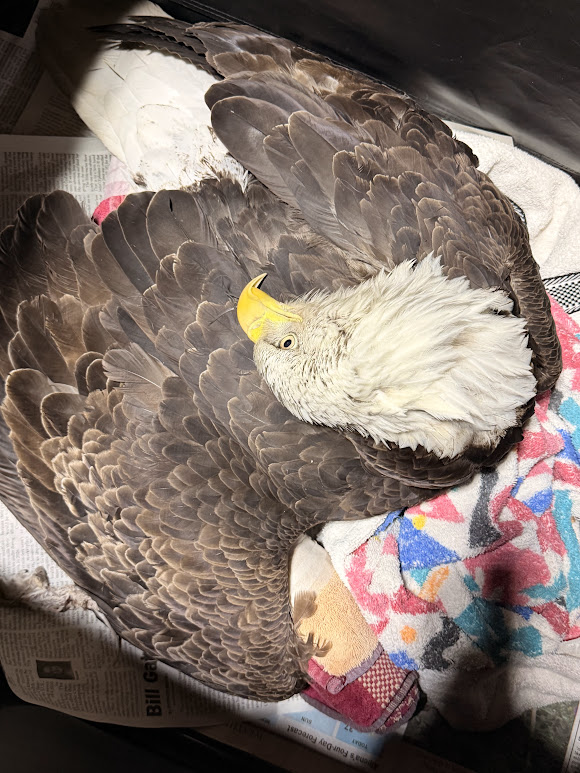
Courtesy photo This bald eagle was taken in by Ashley Kolnowski, owner and operator of Alpena’s Bird Center (ABC). The eagle was transferred to another rehabber in Roscommon and passed away there due to internal bleeding.
ALPENA — An injured bald eagle was found last Wednesday after flying into a ladder truck in Alcona County. The bird passed away early this week due to internal bleeding.
Ashley Kolnowski, the owner and operator of Alpena’s Bird Center (ABC), said she got a call from a Michigan Department of Natural Resources (DNR) officer about the eagle. The officer told her that the bird had run into a ladder truck on Hubbard Lake Road in Alcona County. When the officer got the call he thought the eagle was no longer alive.
Kolnowski said that if a DNR officer finds a dead eagle, they handle it and take it to a repository.
If it is alive, as this eagle was, Kolnowski can take it in for rehabilitation.
“It was very much alive and somebody had moved it over into the woods,” Kolnowski said upon finding the bird.
She said there was clear damage from running into the ladder truck. The bald eagle’s wings were sprawled out, and he was not standing.
“Things like that tell us he was in rough shape,” Kolnowski said.
When she had retrieved the eagle and brought it back to ABC, herself and another rehabber performed an x-ray to determine whether the eagle had broken bones. The x-ray confirmed no broken bones, and Kolnowski verified it with an expert out of Grand Rapids.
The eagle did have some road rash on its wings, as well as significant lead poisoning and internal soft tissue injuries.
Kolnowski said that lead poisoning is a very prevalent issue with bald eagles. They are scavengers and will often consume deer carcasses left from hunters. Those carcasses often have lead bullets or fragments left in them that eagles ingest. They also on occasion ingest lead sinkers from eating fish, another staple of an eagle’s diet.
Kolnowski thinks that the bald eagle was scavenging food on the side of the road and couldn’t fly away fast enough when a ladder truck came by due to disorientation from lead poisoning.
Currently, Kolnowski does not have the treatment to address lead poisoning. She is also waiting on a license from the U.S. Fish and Wildlife Service (FWS) to be able to rehabilitate eagles. Until she is licensed, she is only allowed to do initial care and assessments for eagles.
Kolnowski transferred the bald eagle to the Association for Rescued Kritters (ARK) in Roscommon for further care.
Sadly the bald eagle patient was bleeding internally and passed away early this week. He was medicated and comfortable and in the best care he could be, according to a Facebook post from ABC.
“Sometimes the injuries are more than we can see on x-rays,” the post stated. “We are thankful to have a tool to help diagnose lead poisoning in the patients we intake.”
The eagle’s injuries raise awareness to the importance of moving dead animals out of the road to keep scavengers safe. Additionally, if you notice wildlife on the side of the road, be cautious.
“Slow down when you see wildlife on the side of the road,” Kolnowski said.
Local News
Township responds to structure fire with no smoke detectors

Northeast Michigan TNR (NEMTNR) to host training class

Seasonal boat permits
Alpena’s Bird Center rescues bald eagle hit by ladder truck
Alpena County youth and rec grant application workshop to be held Thursday
Alpena County 2027 Youth and Recreation grant applications are now available on the County’s website at ...
Quilt Guild to meet Thursday
ALPENA - Gone To Pieces Quilt Guild has there monthly meeting on Thursday at the First United Methodist Church in ...