
Year later, residents recall ice storm that slammed northern Michigan
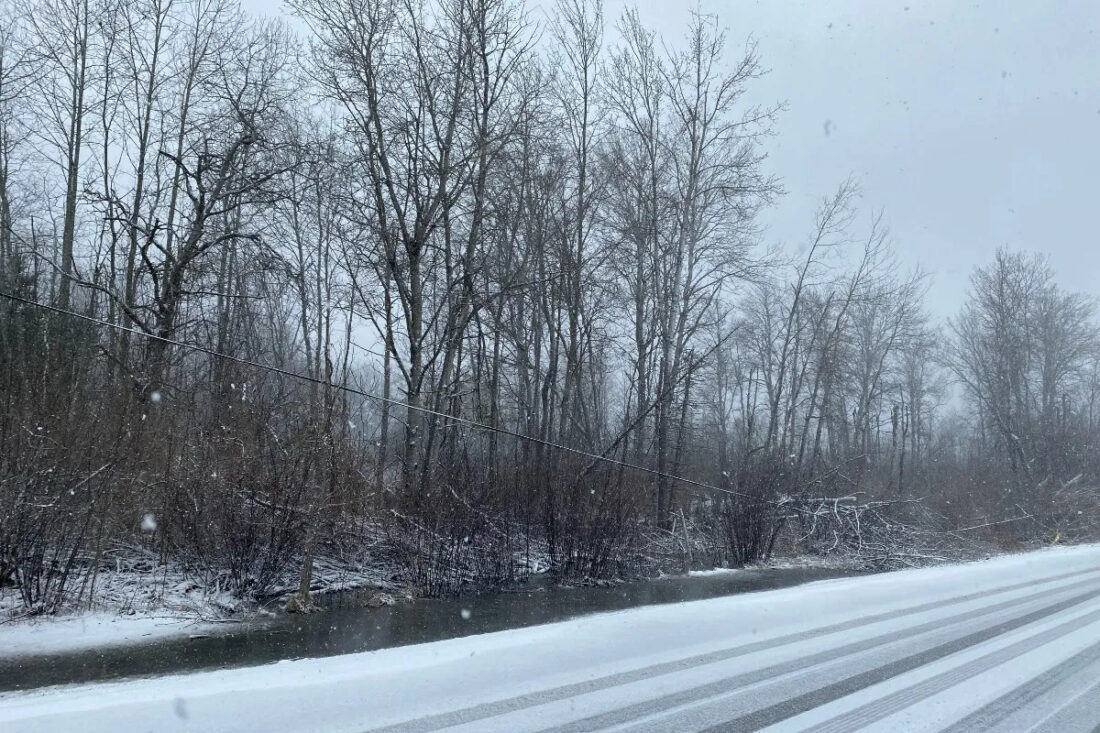
Trees tore down thousands of powerlines during a late-March 2025 ice storm that clobbered northern Michigan and left thousands without power, some for weeks. (Justin A. Hinkley/Bridge Michigan)
GAYLORD — Nearly a year after a devastating ice storm hit northern Michigan, residents gathered in Gaylord on Thursday for a night of storytelling about the extreme weather they experienced.
In late March 2025, more than an inch-and-a-half of ice collected on tree branches, power lines, homes and vehicles across a dozen counties in the northern Lower Peninsula and southern Upper Peninsula. Trees toppled on houses and powerlines and thousands lost power, some for weeks. For some residents, downed power lines and blocked roads threatened access to medical care.
On Thursday, 16 farmers, foresters and residents gathered for an event hosted by the Climate Action Campaign, a coalition of local and state organizations advocating for policies to address climate change.
One goal of the event was to show policymakers the consequences of a lack of aid. The federal government approved recovery dollars for local governments and nonprofits but denied Gov. Gretchen Whitmer’s request for aid for utilities and individuals. A bill in the state Legislature that would allocate $100 million to relief efforts stalled in the state Senate.
Participants in Thursday’s event recalled harrowing experiences of the storm but also shared stories of communities supporting each other in the aftermath.
“What I remember most from this isn’t the destruction, it’s the way people showed up,” said Aaron Beach, an operations leader at Treetops Resort in Gaylord. The resort hosted emergency crews that helped restore power to the area.
Resident Patrick King was injured during the storm and called 911. Emergency responders said help would be on the way, armed with chainsaws to cut through the debris littering King’s road. King and his wife told them not to come because others might be in worse condition.
“There’s people who might be having heart attacks, having strokes,” he said. His wound was “no reason to divert a crew and have them sit there for the hours it’s going to take to get to us.”
Instead, King got medical help from a neighbor who is a retired nurse.
Several speakers looked at the work ahead for recovery, while calling attention to how ice storms like last year’s could become more common because of climate change. Research suggests the freezing line in Michigan is shifting north, which means places where snow is more common could see more icy rain in the future
That worries Charlevoix resident Lesley Pritchard, who said federal rollbacks to climate regulations and environmental protections are “frightening” as extreme weather worsens.
“This White House and this Congress have continued to gut the agencies and the research and eliminate the protections we fought decades to establish,” she said.
President Donald Trump has called climate change a “hoax” and has shifted federal support from green energy to fossil fuels.
Foresters at the event spoke about the long-term effects of the ice storm on the region’s trees. The storm impacted about 3 million acres of trees.
“The overall economic value of the forest is and will be degraded. And we’ll see that for many decades in the future,” said Ivan Witt, a Gaylord-based private forestry consultant.
But he said the destruction isn’t permanent, and recovery will happen even if it takes a generation.
Donna Farvard, state organizing director for the Climate Action Campaign, said the goal of the event was to let people share what their lives have been like since the storm and speak directly to elected officials. Leaders from the Michigan State Police and a representative from US Sen. Gary Peters’ team attended the event.
“Our hope is that the government officials in attendance take these stories back with them and have a renewed charge to advocate for the assistance the community needs to not only better prepare for future storms, but also to advocate for policies that will address climate change,” she said.
Despite all the devastation, Beach, the operations leader from Treetops Resort, compared the community’s strength during and after the ice storm to buffaloes.
“Because when a storm comes, buffaloes don’t run away from it,” he said. “They run into it, they face it head on together and they get through it faster.”
This reporting is made possible by the Northern Michigan Journalism Collaborative, led by Bridge Michigan and Interlochen Public Radio, and funded by Press Forward Northern Michigan.
Local News
Posen VFW chicken dinner
POSEN — The VFW Posen Post 7804 Auxiliary will host a chicken dinner on Sunday from 3 p.m. until 6 p.m. The ...
Load restrictions in Alcona County
In accordance with the provisions of Section 722 of Act No. 300 of the Public Acts of 1949, as amended, the Alcona ...
Habitat seeking donations
ALPENA — Habitat for Humanity Northeast Michigan are seeking spring donations people with items to donate can ...
Red, white, and blue

Perfectly pink
MyMichigan accepting book donations
ALPENA — MyMichigan Medical Center is now accepting gently used hard and soft-covered novels, kid books, and ...