Trapping is necessary for management of wildlife populations
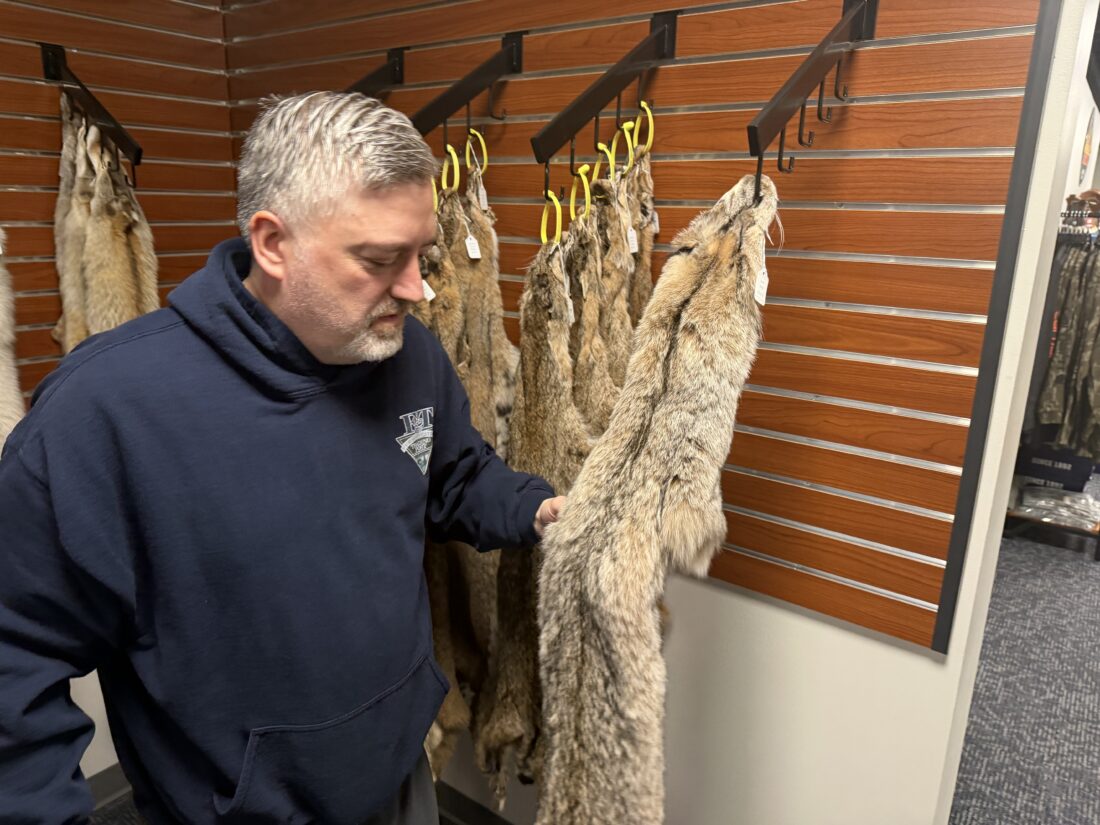
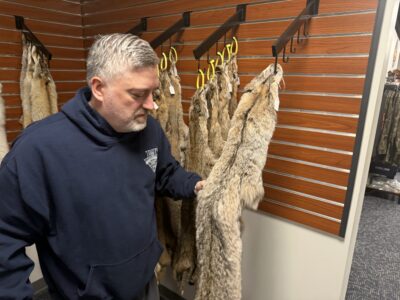
News photo by Kayla Wikaryasz On Friday, Shawn Inglis, co-owner of F&T Fur Harvester’s Trading Post, is seen holding a lynx pelt at F&T Fur Harvester’s Trading Post in Alpena. The retail location ships and sells animal pelts, trapping gear, and more.
ALPENA — Local store owners say that trapping is necessary to manage wildlife populations and to protect farms and livestock.
Ralph Inglis, co-owner of F&T Fur Harvester’s Trading Post in Alpena, explained that trapping game is “just another form of hunting.”
He said that trapping is an outdoor activity that interests outdoor-enthusiasts just like hunting or fishing does.
“Trapping is just an independent form of hunting,” Ralph Inglis added.
He explained that each state determines how species of wildlife are classified and whether or not they can be targeted for trapping reasons.
According to the Michigan Department of Natural Resources (DNR), Michigan has 17 species of furbearers that can be harvested using hunting or trapping methods. The term “furbearer” is generally defined as species that historically have been harvested for their fur.
The DNR also states that most of Michigan’s furbearer species are carnivores, with a few exceptions such as beaver and muskrat.
“Fur harvesting has played an important role in the lives of many Michigan residents since long before statehood and has continued to the present day,” the DNR states on their website.
The DNR allows year-round harvesting for opossums, skunks, and weasels, and hunters can use all legal hunting and trapping methods for those species statewide, with a valid Michigan fur-harvesting license. There are no bag limits for these species.
Beavers, coyotes, muskrats, opossums, raccoons, skunks, and weasels can be harvested year-round, using all legal hunting and trapping methods for those species, on private property when doing or physically present where they could imminently cause damage, according to the DNR.
The DNR defines “damage” as physical harm to forest products, roads, dams, buildings, orchards, apiaries, livestock, and horticultural or agricultural crops. Beavers or muskrats are only considered to be doing damage if their activities result in flooding or culvert blockages that cause damage. A license or written permit is not needed.
Ralph Inglis explained that in Michigan — and across the country — trapping is used for crop damage prevention, harm reduction to livestock, recreation, and more. Segments of the population who practice trapping include federal and local governmental agencies, independent animal control contractors, and individuals who enjoy the sport.
Ralph Inglis said that the United States Department of Agriculture is “heavily involved” with trapping fur-bearing predators on the west side of the state due to the number of farms raising livestock for meat which is shipped across the country.
“There’s a full time effort, around the clock, by the government to kill predators, like coyotes,” Ralph Inglis added. “If not, it would be very hard to successfully raise any farm animals in environments like that, because the predators would kill them all.”
“It’s an ongoing effort by the U.S. government and the state governments to protect the nation’s food supply,” he added.
Ralph Inglis said that trapping is an effective tool for wildlife management.
“The number one most effective way to get rid of predators is through trapping,” he explained.
On the local level, Ralph Inglis said that municipalities employ trappers for wildlife management. He said that these trappers are vital for local infrastructure.
“Three or four years without them, most roads would be impassable,” he said. “Beavers would put dams on one side or the other and they’d flood.”
Shawn Inglis, co-owner, said that recreational trapping has become more accessible since the advent of the internet where individuals can learn the basics of trapping without needing a family member or friend experienced in the sport to teach them. He also said that the popularity of the show “Yellowstone” spiked a demand of high-end cowboy hats that are made with beaver felts, the underfur of the beaver.
This demand flooded the pelt market and drove more people to the trapping sport.
“More people trapped more animals because the prices spiked up,” Shawn Inglis said.
He added that “government trappers” enjoy higher prices for pelts because then they are not needed to fill in the trapping gap.
“Recreational trappers aren’t doing it? The government trappers have to,” Ralph Inglis added.
Both Ralph and Shawn Inglis said that the term “trapper” does not define a person but merely defines their interest.
“Just like calling a ‘golfer,’ a guy that likes to play golf … he’s not a ‘golfer,’ he works as a salesperson and he happens to golf a little bit,” Ralph Inglis said. “That’s how most recreational trappers are. They’re not trappers … they’re just regular people.”
Below are statewide seasons for harvesting fur-bearing animals in Michigan:
– Coyote hunting occurs from July 15 to April 15
– Fox (gray and red) hunting occurs from Oct. 15 to March 1
– Opossum hunting occurs year-round
– Racoon hunting occurs from Oct. 1 to March 31
– Skunk hunting occurs year-round
– Weasel (short-tailed/ermine and long-tailed) hunting occurs year-round
Kayla Wikaryasz can be reached at 989-358-5688 or kwikaryasz@TheAlpenaNews.com.
Local News
Snowmobile race in Lincoln
Alpena received higher than normal snowfall in February
Alcona County police update
Recent actions taken by law enforcement agencies in Northeast Michigan. This has been only lightly edited. ALCONA ...

Gov. Whitmer proclaims March 2026 as March is Reading Month
Trapping is necessary for management of wildlife populations