New master plan presented at APS ‘Reimagine our Future’ community forum
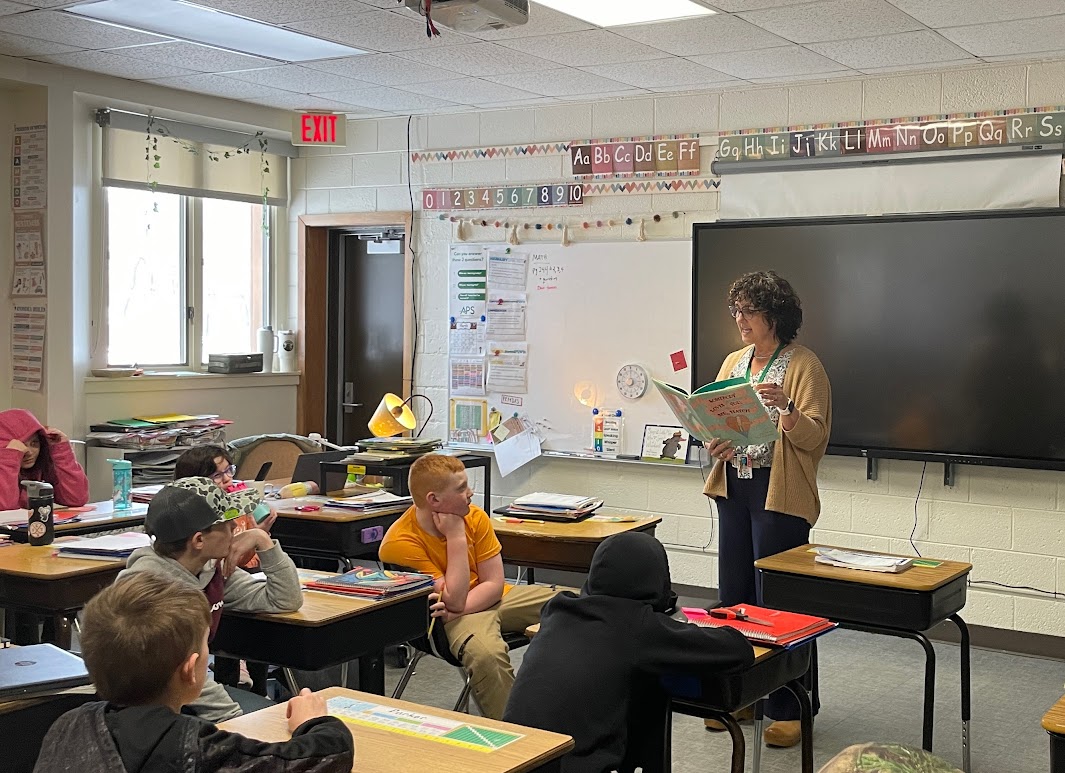
Courtesy Photo Stephanie Piper, Alpena Public Schools K-5 curriculum director, reads to students at Hinks Elementary on March 10.
ALPENA — Alpena Public Schools hosted a second “Reimagine our Future” community forum on Tuesday night, when representatives from KingScott, an architecture firm, presented an updated facilities master plan.
The first forum took place in November when KingScott representatives shared the results of a district-wide facilities study and offered two master plan ideas for the future of APS facilities.
In both master plan scenarios, the former Sunset Elementary and the APS central office on Gordon Road would both shut down and the programs taking place in those buildings would be moved elsewhere.
The first master plan scenario suggests Sanborn and Wilson Elementary host kindergarten through sixth grade students. Besser and Ella White Elementary would house kindergarten through fourth grade, and the Thunder Bay Junior High (TBJH) Building would be repurposed as an intermediate school, hosting fifth and sixth graders.
The second master plan scenario suggests that Wilson and Sanborn Elementary would both house pre-K through fifth grade students. Ella White Elementary would become a lower elementary school for kindergarten through second grade students; Besser Elementary would become an upper elementary for third grade through fifth grade. Hinks Elementary would become a junior high magnet school for grades sixth through eighth grade students, and TBJH would remain as is for grades sixth through eighth.
Since that forum, the community has had the chance to respond to a survey, which received around 250 responses.
KingScott President Rob Atkins and Project Director Laura Casai presented more data and responded to the public’s feedback from the survey at Tuesday’s forum.
Survey results showed that most people agreed that maintaining rural schools matters and all students should have similar access to high quality facilities. There is a strong preference for renovating existing schools over new buildings, and strong support for repurposing underused buildings for community benefit.
There is also support for a designated middle school building for grades sixth through eighth, and there is support for implementing kindergarten through sixth grade schools.
Additionally, the survey respondents felt that transportation increases are not viable. Large scale grade reconfiguration, such as having upper and lower elementaries, is not supported either.
The APS district is projected to lose 82 students by the 2029-2030 school year, Casai said in the presentation. That means the district is barely breaking even financially as it currently stands. A loss of 150 to 200 students would be a “tipping point,” Casai said.
Casai presented data showing that the district overall has an excess amount of square footage to utilize.
She showed a graph relating energy cost to population density at each school. Ella White Elementary, TBJH, and Besser Elementary each have high population densities and lower energy costs, begging the question of how to fit more of the schools in that bucket.
Casai presented a matrix comparing the energy efficiency and utilization of each building, which showed Ella White as a benchmark for efficiency and utilization of space. Wilson Elementary is on the opposite end of the spectrum with inefficient energy use and a tight utilization of space.
Casai noted that HVAC and systems upgrades would be needed there to make the building more efficient.
Atkins presented a new master plan based on community feedback from the last forum and data from the district.
“What our master plan is evolving into is kind of a three phase recommendation,” he said.
Phase one entails reducing and balancing energy costs so more dollars are directed toward students and programs.
Adkins proposed investing in operational efficiency in APS buildings, leveraging enhanced programs and student experiences to help position APS for long-term enrollment stability, and investing in the quality of learning environments for students to reduce crowding, support relevant programming, and provide equity across all classrooms.
Phase one could potentially attract more students to the district and help reverse or mitigate the current downward trend in enrollment.
In phase two, Adkins proposes reducing the operational square footage of the district by optimizing the use of space at Alpena High School and relocating Central Office functions. To accommodate the reduction in enrollment across the elementary schools, he proposed to rebalance elementary boundaries and shift sixth grade into elementary buildings. The proposal is in service of keeping all current elementary buildings open.
In phase three, following the implementation of the first two phases, APS will continue to monitor enrollment and facility utilization trends.
If sustained enrollment decline beyond current projections results in significant underutilization that impacts program quality, equitable access, or financial stewardship, the district would initiate a formal evaluation of strategic consolidation.
The goal of phase one is to push phase two and three further down the road, Superintendent Dave Rabbideau said. If phase one is successful, it could potentially change enrollment trends.
“This is the first facility master plan we’ve done where we don’t want you to get to phase three,” Atkins said.
Casai said it will take a minimum of four years to make it to phase two, but could potentially be pushed out further than that. After phase two, the goal is to push phase three out as far as possible. If enrollment changes, the strategic consolidation in phase three may not need to be enacted at all.
Casai listed improvements that could be made to each building in the district in phases one and two, with many of the buildings needing improved insulation and windows to promote energy efficiency. Part of the recommendation is to move the administration offices to Alpena High School in F House, which was proposed in the original master plan, scenario two.
After Adkins and Casai presented, they allowed some time for community members to collaborate and generate ideas for phase three.
The audience was asked to design a decision making framework answering the question, “If closure is required, what objective criteria should be evaluated to determine which building would be consolidated?”
Another survey has been started to answer what the most important criteria are to consider for building consolidation.
Reagan Voetberg. News Staff Writer. rvoetberg@TheAlpenaNews.com.
Local News
Rx Kids expands to all expectant mothers and families in Montmorency County
MONTMORECY COUNTY — Michigan State University’s Rx Kids program, in partnership with the Thunder Bay Community ...
New master plan presented at APS ‘Reimagine our Future’ community forum
Alpena was well prepared for the storm, says Modrzynski

Gov. Whitmer and MiLEAP announce record enrollment in PreK for All

Thunder Bay Community Health Service and Munson Healthcare announce partnership to expand prenatal care access in Northern Michigan