Gas prices continue to rise in Michigan and across the country
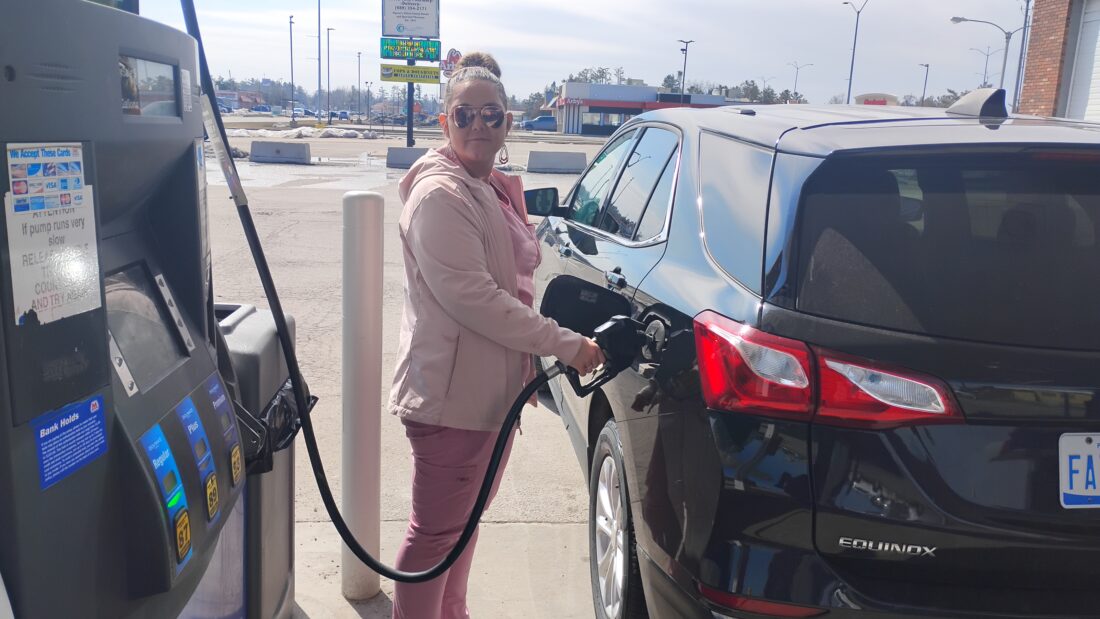
News photo by Josh Jambor An Alpena resident is pictured filling her vehicle with fuel. Gas prices continue to climb amid the ongoing United States and Israel military campaign in the Middle East and seasonal changeover in gasoline formulations.
ALPENA – As of 4:30 p.m. Monday, the cheapest location for regular unleaded fuel in the Alpena area was $3.80 per gallon at the BP gas station on U.S.-23 North, according to GasBuddy.
The average cost per gallon in Alpena County was $3.94 and the highest price per gallon for regular fuel was $3.99 at the Sunoco gas station on Long Lake Avenue and Opechee’s on U.S.-23 North.
GasBuddy reported on Monday that the lowest price per gallon recorded in Michigan was $2.99, with an average per gallon price of $3.93.
The average price of gas has escalated since the beginning of February when gas prices were averaging around $2.86 a gallon in the United States. Currently, the price of regular unleaded fuel is averaging around $3.95 per gallon.
According to data from AAA, the national average one year ago was $3.08 per gallon and $3.04 per gallon in the state of Michigan. A month ago, the national average was $2.93 and the state average was $2.98 per gallon.
For 2025, AAA reports the lowest price per gallon was $2.72 on Dec. 22 and the highest price per gallon was $3.39 on Aug. 27.
Patrick De Haan, senior petroleum analyst for GasBuddy, told The News that the military presence in the Middle East has impacted oil prices. He said that oil prices rose from $57 at the start of the year to $65 when the “threat of the US attacking Iran became imminent.”
“Obviously the situation in the Middle East is having an impact,” De Haan said. “Since then, we have risen to around $103 a barrel.”
“I would probably say that three quarters or more of the reason for the jump in prices has been what’s happening in the Middle East,” De Haan added.
De Hann explained that another reason for the escalation in fuel prices is seasonal changeover. That changeover is a twice-yearly shift in gasoline formulations produced by refineries and sold at retail stations to accommodate changing weather conditions and EPA environmental regulations.
“We are also seeing seasonal changeover in gasoline impacting prices as well. This is the time of the year when refineries make the transition to cleaner versions of gasoline as required for the summer,” De Haan said.
De Haan said he would not be surprised if the prices at the pump continued an upward trend.
“I would not be surprised if we continue to see gas prices going up, not on a daily basis, because Michigan generally is a state where we see gas prices cycle,” De Haan said. “Every week or so stations will raise prices considerably, then they start undercutting their competitors by lowering prices for a period of five to seven days before re-raising prices.”
Regular unleaded fuel peaked in Michigan at $4.19 last week and De Haan believes Michigan gas prices will approach that mark again soon.
“Gas prices in Michigan jumped up last week to $4.19. They have been inching back down a bit, but I do think that they will go back up to $4.19 a gallon at some point this week,” De Haan said. “Again, 75 to 85 percent of what’s happening with how high prices are revolve around the situation in Iran.”
De Haan said that the trajectory of fuel prices in the United States is uncertain as the military conflict in the Middle East continues.
“It’s a little uncertain how much higher gas prices will go, a lot of it is contingent on what could happen in the Middle East and the path the United States picks,” De Haan explained. “Will they engage in a ground war? There are a lot of different ways it could go.”
De Haan explained an additional contributing factor for higher gas prices is the Strait of Hormuz, which handles roughly 20% of global oil consumption and 20% of liquefied natural gas. The U.S. can travel the Strait; however, Iran has threatened to attack any United States Israeli, or allied vessels attempting the passage.
“Essentially, at the end of the day, what’s most critical for the price of oil is that the Strait of Hormuz is essentially still blocked,” De Haan said. “The Strait of Hormuz carries about 20 million barrels of oil on a daily basis from countries like Kuwait, Iraq, and Saudi Arabia to the global market.”
Josh Jambor can be reached at jjambor@thealpenanews.com.
Local News
Quilt Guild to meet Thursday
ALPENA - Gone To Pieces Quilt Guild has there monthly meeting on Thursday at the First United Methodist Church in ...

Rollover crash in Harrisville

Lifelong Learners release next week’s schedule
Gas prices continue to rise in Michigan and across the country
Aid by the Dozen hosts monthly meeting
ALPENA — Carol Kelly chose March 25 to host the Aid by the Dozen monthly meeting. The monthly donation went to ...