
Bills would provide tax credits for volunteer firefighters, EMS personnel
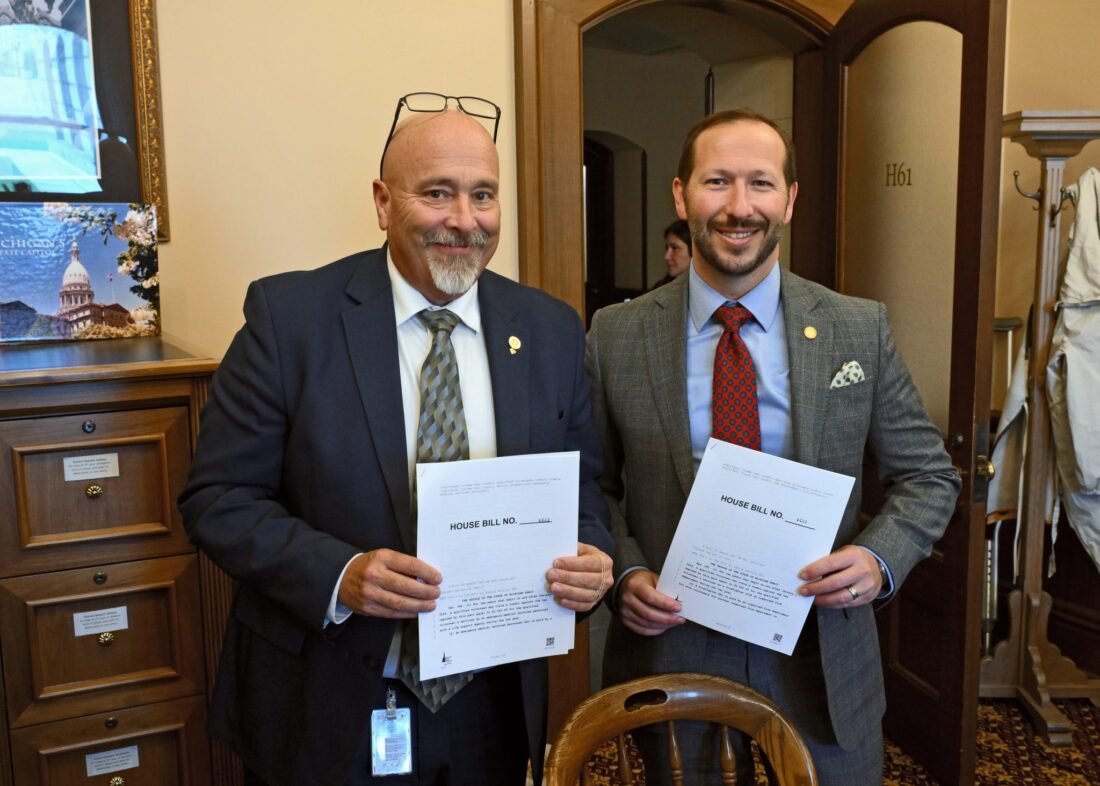
Courtesy photo by Michigan House Republicans Reps. Steve Frisbie, left, of Battle Creek, and Matthew Bierlein, of Vassar, hold copies of their tax credit bills.
LANSING – While fire departments and EMS agencies across the U.S. face recruitment and retention challenges, volunteers play a vital role in providing life-saving services in Michigan.
Now, lawmakers are looking towards tax credits as a way to acknowledge these workers.
Bills by Reps. Matthew Bierlein, R-Vassar, and Steve Frisbie, R-Battle Creek, would provide a $2,500 annual state income tax credit for volunteer firefighters and emergency services personnel.
“We’re really just looking for any way possible to try and get more people involved – and retain people who are already involved” in these positions, Bierlein said.
In Michigan, many fire departments and EMS agencies rely on volunteers, especially in small towns and rural areas.
Bierlein – who represents some of those communities – said the vast majority of firefighters and many EMS workers in his district are volunteer or paid on-call.
They may receive a small stipend for responding to an incident, “but they are not professionals by any means,” he said. Some have full-time jobs outside the fire department, others are retirees.
While nearby bigger cities – like Saginaw, Bay City and Flint – may have paid professional staff, “everybody else runs on volunteers,” he said.
Friesbie said, “It’s related to call volume.” It’s rare to see departments with a volunteer base in urban and suburban centers, where the frequency of calls is higher.
In such areas, volunteers don’t want to – or can’t afford to – leave their jobs multiple times per day to respond to the number of emergencies that arise, Frisbie said.
Plus, “having available, trained, capable staff then becomes a burden on the taxpayer,” he said. Fire departments are funded by the local government, often through property taxes imposed on residents.
While cities tend to pay career firefighters to ensure reliable service in these high-call-frequency areas, Frisbie said smaller communities can’t afford to staff a department on a full-time basis.
“It’s just beyond their reach and their budgets,” he said.
According to the National Fire Department Registry, 62.3% of the 976 voluntary registered fire departments in Michigan are categorized as “volunteer,” meaning that 100% of their firefighters are volunteers.
Another 23.3% are registered as “mostly volunteer,” where not more than half of the staff are career firefighters.
As many fire departments provide some emergency medical services, Michigan’s EMS agencies also count on volunteers, though the overall percentage is lower.
According to the Department of Health and Human Services, out of the 798 licensed EMS agencies in Michigan, 20.6% self-reported as “volunteer” and another 27.9% as “mixed.”
Angela Madden, the executive director of the Michigan Association of Ambulance Services, said volunteer EMS agencies are becoming “fewer and fewer.”
As the population ages and call volumes increase, it is not sustainable to be strictly volunteer anymore. “We have fewer people willing to volunteer to do that much work,” she said.
Plus, EMS volunteers – like paid personnel – must complete education programs and later maintain their license, Madden said, requiring them to invest both time and money.
According to the U.S. Fire Administration, “Recruitment and retention have become [two] of the biggest challenges facing the U.S. fire and emergency services in recent decades.”
Even though volunteering has been “an integral part of American society” since the nation’s founding, the number of volunteers has declined in the past decades, said an agency report.
The trend indicates “that volunteerism in the fire and emergency services has not kept pace with population growth,” the agency said.
Frisbie said it’s a societal thing:
“People want to be remunerated for every minute that they are working – and that’s okay, too,” he said. “But I think they have lost sight of the value of being a part-paid and volunteer in your community – and the reward it brings you to be able to help your fellow citizens.”
Bierlein said one big factor that’s driving the problem in small towns is the lack of jobs in the local community.
For example, consider his hometown of Vassar in Tuscola County: While it’s always been a small town, “the big difference between then and now is the number of jobs that are actually in town,” he said.
Vassar used to have a large food distribution warehouse, a foundry that ran multiple shifts and a stamping plant that made parts for the automotive industry.
Their employees were often volunteers in the fire department and when there was a fire, those businesses used to let them leave to fight it, Bierlein said.
But with these jobs now gone, more people work outside of town. And “you can’t leave from five towns over and come back and go fight a fire because there was a call – it’s too late by then,” Bierlein said.
According to the U.S. Fire Administration “Employers are also less likely to let their employees leave during the day to respond to calls than they were in the past,” which makes coverage during traditional working hours more difficult.
Frisbie said, “If you’re trying to make ends meet, it’s hard for you when your pager goes off as a firefighter to leave your well-paying job with benefits.”
While some employers keep employees on the clock while they go fight a fire, Frisbie said, “that’s dangerous in today’s world” because of workers compensation laws and other aspects of the legal system.
“It’s just a lot more complicated than it was when I started in the fire business in 1981,” he said.
Before being elected to office, Frisbie served as a volunteer firefighter, in addition to being a paramedic and ambulance service administrator.
As the number of people available to join local departments has shrunk, Bierlein said, retention of existing volunteers is important.
This is where the proposed $2,500 tax credit comes from.
“I don’t know if it’s an incentive enough to get people to join. But we want to make sure that we are keeping the people we have,” he said.
By introducing the bills, the sponsors join other Midwestern lawmakers seeking to address recruitment and retention challenges through tax credits as an incentive.
For example, Illinois already has a volunteer emergency worker credit.
It allows volunteers in fire departments, emergency and disaster agencies to shave off $500 of their tax liability. Now, a bill introduced last year calls to increase that amount to $1,000.
According to a Michigan House Fiscal Agency analysis, the bills would reduce state revenue by between $60 million and $70 million a year based on current estimates of volunteers.
About 3/4 of the revenue loss would be for firefighters using the credit, with the remaining 1/4 attributable to EMS personnel.
The bills passed the House Finance Committee and are awaiting action by the full House.
Frisbie said he doesn’t see it as a partisan issue.
Supporters include representatives from both sides of the aisle, including: Tom Kunse, R-Clare; Carrie Rheingans, D-Ann Arbor; David Prestin, R-Cedar River; Samantha Steckloff, D-Farmington Hills; Gina Johnsen, R-Portland; Jennifer Wortz, R-Quincy; and Jason Woolford, R-Howell.
“I think there’s pretty much universal support for fire and EMS,” Frisbie said.
Michigan News
Bills would provide tax credits for volunteer firefighters, EMS personnel

Whitmer announces Operation Safe Neighborhoods has taken nearly 950 Illegal guns off the street

Michigan launches member benefits program to support National Guard service members and families
Gov. Whitmer declares state of emergency in Alcona and Alpena counties

Peters, Slotkin press National Weather Service for answers on lack of tornado watch for Michigan tornadoes