
Research centers in the Great Lakes region change the scope of global freshwater ecology
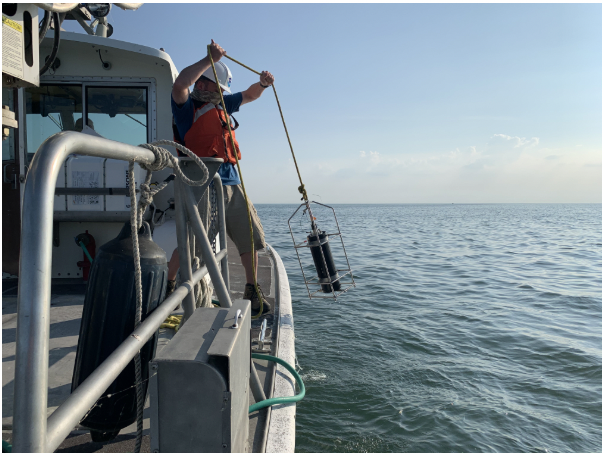
Courtesy photo Sampling water in western Lake Erie. Credit: Great Lakes Environmental Laboratory.
LANSING – A new study examines the uniqueness of work that research centers conduct in the Great Lakes region, highlighting their importance amid dramatic changes in federal funding.
“I’m a Great Lakes researcher, so my goal is to work with others in this region to establish a regional water center. From my environmental scan, I came upon some ideas about what might potentially be a successful model,” said Michael Twiss, a biology professor at Algoma University in Ontario.
Twiss also uncovered a key problem in current research centers.
“One of the emergent properties that I saw was that existing regional water centers on the Great Lakes weren’t doing a good job at addressing Indigenous concerns,” he said.
“The region is multinational, with Canada and the United States, and there’s about 125 recognized Indigenous nations in the region,” he said.
“I would like to see the regional water center as truly collaborative,” he said.
Catherine O’Reilly, the director of the Large Lakes Observatory at the University of Minnesota Duluth, said her center focuses primarily on the impact of algae blooms.
She said that an important contribution of Great Lakes centers is the ability to conduct research on a vast body of water.
“One of the things we are able to do in this region is monitor what’s happening locally to understand how changes are propagating through the Great Lakes system,” O’Reilly said.
Ashley Moerke, the executive director of the Center for Freshwater Research & Education at Lake Superior University, highlighted the diversity of research from each center.
She said her center concentrates primarily on fisheries ecology, fishery science and food and invasive species.
“In the last couple of years, we kicked off a large international project that is focusing on the potential impacts of oil spills in freshwater. We do some emerging contaminants work as well,” Moerke said.
“Students also run a fish hatchery, where we raise and stock Atlantic salmon into the Great Lakes, and we provide all the eggs for the Michigan Department of Natural Resources,” she said.
Research centers in the region also work together as a collaborative that complements each of them, and so the network of research centers is vital, Moerke said.
“It’s complementary so we can ask big questions across big scales,” Moerke said.
Budget cuts by the Trump administration have targeted scientific institutions, directly affecting the research development at Great Lakes centers, according to Moerke and O’Reilly.
Moerke said, “Federal funding has always been critical to Great Lakes research. The Great Lakes cross state boundaries, so they aren’t state issues, and a lot of the projects we work on need federal funding to create those cross-collaborations.”
O’Reilly added that federal money is essential to create management strategies in local communities if a new invasive species is found in an area.
“With reduced federal funding, we will not be able to monitor how the lake is changing or how it’s responding to certain events,” O’Reilly said.
Federal funding is important to provide information that allows communities to ensure that they understand what’s happening in the lake so they can make better decisions about how to manage it,” O’Reilly said.
However, Twiss acknowledged that centers have multiple avenues for funding, especially through their academic institutions.
He said those other sources include state governments and industry.
The researchers said the public has a number of ways to support Great Lakes research, including engaging with participatory science.
“The biggest thing you can do is make sure you stay engaged and let your voice be heard in the community when decisions are being made. Awareness will help everybody stay informed,” O’Reilly said.
The study appeared in the Journal of Great Lakes Research.
Local News
CTE and Industry Expo at Alpena High School
Trinity Episcopal soup sale
Corey bound over on child abuse charge, Horton child abuse charge dismissed

Exchange Club of Alpena presents to DABS league

Spring break at the Thunder Bay Marine Sanctuary
