
Michigan’s Independent Retailers urge Whitmer to seek repeal of the Bottle Bill
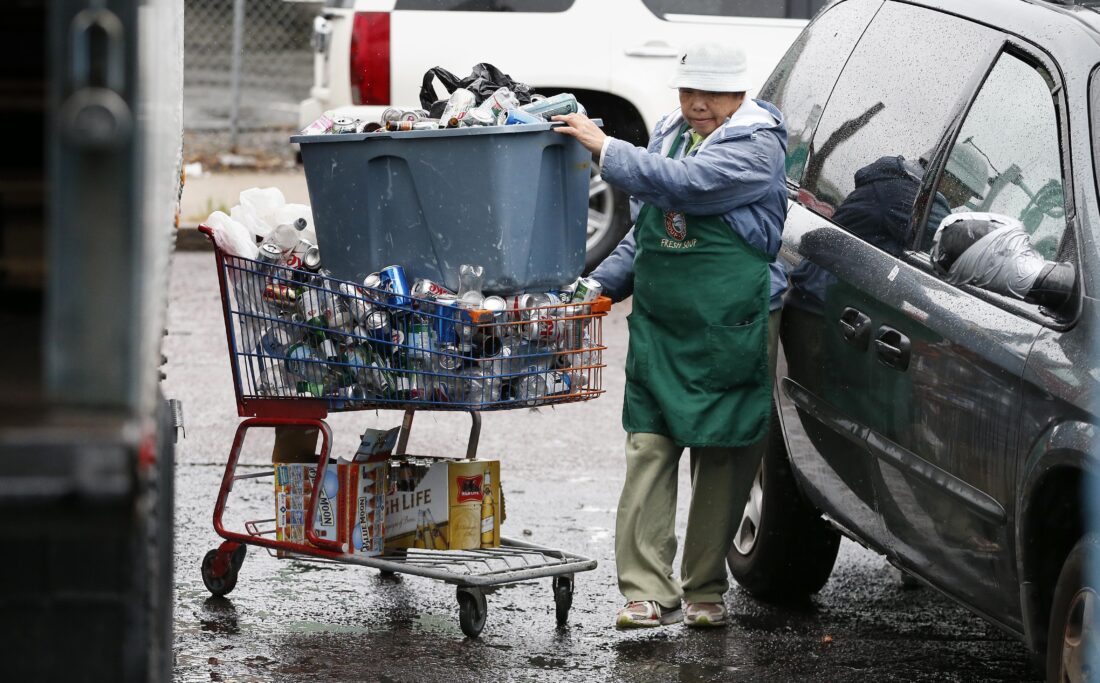
AP file photo A man with a cart of can and bottle returns pushes them through a parking lot to be returned.
LANSING — The Midwest Independent Retailers Association (MIRA) On Monday, called on Gov. Gretchen Whitmer to request the repeal of Michigan’s Bottle Bill law during her State of the State address on Wednesday.
MIRA encourages Whitmer to start a transition away from Michigan’s costly, inconvenient, and increasingly ignored 1970s-era bottle deposit system that creates health hazards inside our food stores. Instead, Michigan must accelerate its move toward modern curbside and community-based recycling programs that better reflect how Michiganders live, shop, and recycle in 2026.
“We commend Governor Whitmer for her broader efforts to improve Michigan’s recycling rate and invest in a modern recycling infrastructure,” said Bill Wild, president and CEO of MIRA. “The governor’s final State of the State address is a great opportunity to start the transition away from this outdated law and move more quickly toward a modern curbside recycling system, something MIRA will fight for in 2026.”
“It’s time to recycle the Bottle Bill,” Wild concluded.
Despite the importance of recycling, Whitmer has not directly addressed the Bottle Bill issue in previous State of the State speeches. However, 2026 presents a great opportunity for these reasons and more:
Cut costs and inconvenience for families: Whitmer and legislators can cut costs for Michigan families by eliminating required bottle deposits (and the extra work required to get their money back), while also slashing more than $100 million per year in program costs that pressure food prices.
Original purpose is diminished: While the bottle deposit law once served the admirable purpose of reducing roadside litter, five decades later public attitudes about protecting our environment and recycling have improved, and “adopt-a-road” programs have empowered groups to clean and maintain roadways.
Participation is collapsing, but family funds kept by the government: Consumer frustration with the process has resulted in a participation drop of around 30% from the law’s peak. Worse yet, unclaimed family grocery money is not returned to consumers but instead devoured by program costs, anti-fraud efforts and the vast majority that is being spent on programs unrelated to recycling.
Remove filthy containers from food stores and instead boost curbside recycling: Protecting public health has remained a top issue since the pandemic, so why would the state continue mandating that dirty – even hazardous – containers be brought inside retail food stores? Repeal the Bottle Bill to protect public health and redirect these valuable recyclables to the curbside recycling system.
Additional Background on Repealing the Bottle Bill
The Bottle Bill has lost its original purpose: The Michigan Department of Environment, Great Lakes and Energy (EGLE) says more Michiganders than ever have access to recycling, while other programs help fight litter:
– Increased public awareness about environmental protection and the use of volunteer “adopt-a-road” programs are limiting litter, which had been the original intent of the Bottle Bill.
– Improved curbside recycling helped increase Michigan’s recycling rate from 14.25% before 2019 to 25% in 2025 – even as the Bottle Bill was in decline.
– About 75% of the state’s population has access to recycling, with more than 60% having access to curbside services.
– EGLE and The Recycling Partnership have distributed more than 333,000 new curbside recycling carts that help more than 1.2 million residents recycle.
– EGLE has granted millions to communities for local recycling drop-off facilities.
– Diverting valuable aluminum and glass to municipal recycling streams would strengthen the economics of local recycling programs.
Repeal will relieve families of costs and inconvenience: Repealing the Bottle Bill would keep more funds in shoppers’ budgets, end the requirement for them to do extra work just to get their own money back, and slash program processing costs that only create cost pressures on groceries.
– A recent poll by The Detroit News showed that food costs are a huge issue for Michigan residents. 64% told pollsters that household costs went up in the past year, with 82% saying that food and groceries rose the most.
– In addition to lowering direct food costs at the store, a 2025 report by the University of Michigan said the Bottle Bill creates $127.7 million annually in cost pressures on the retail industry ($34.91 million for distributors and $92.81 million for retailers). A repeal would cut costs and the pressures they create on food prices.
Stranded family grocery money is not returned to consumers, nor spent on recycling: Evidence is clear that the outdated Bottle Bill is fading and, worse yet, trapping family grocery money in unrelated state spending programs instead of family pocketbooks.
– Due to inconveniences consumers have in retrieving their own money, unclaimed Bottle Bill funds have grown from $33.8 million in 2017 to $116.4 million in 2024.
– 75% of this family grocery money is funneled to EGLE for non-recycling spending, 25% is lost to the burdens of operating the program, and consumer funds are even required to fund law enforcement efforts to fight criminals who defraud the system!
Bottle Bill participation is dropping fast: Fewer consumers are willing to participate, citing inconvenience and the availability of curbside recycling as reasons why Bottle Bill returns are in rapid decline.
– Bottle Bill return rates are falling fast, down to 70.4% in 2024 from a nearly 100% level in years past, according to the Detroit Free Press.
– University of Michigan experts noted that return rates were dropping even before the pandemic because of the expansion and convenience of modern curbside recycling programs.
Expanding the Bottle Bill is not an option: The 50-year-old Bottle Bill applies primarily to carbonated beverages–a big category in the 1970s but one that represents only a part of today’s market.
– Expanding beverages subject to the Bottle Bill would make groceries more expensive for families. For example, the cost of a $3.69 case of water would rise by $2.40 to a stunning $6.09, if the current Bottle Bill was expanded.
– The University of Michigan notes that such an expansion would represent “…a major sensitivity in the state as far as disproportionately affecting lower-income residents, particularly in places like Flint, where many folks are still purchasing bottled water…That higher upfront cost could be seen as a barrier to some folks.”
Michigan News
Michigan’s Independent Retailers urge Whitmer to seek repeal of the Bottle Bill

Nominations open for MVAA’s ‘I Am a Veteran’ campaign

USDA announces enrollment period for farmer Bridge payments

Whitmer and Michigan Department of Education announce Michigan’s high school graduation rate reaches record high
New episodes of Outdoor Channel’s ‘Wardens’ – featuring Michigan DNR
The Michigan Department of Natural Resources continues its partnership with the Outdoor Channel production of its ...
After nixing castration, Iron Mountain to close deer pen. Can it save the herd?
In Michigan’s Upper Peninsula, Iron Mountain wants to close a costly deer pen that has attracted visitors to its ...