Meyerson reiterates health department’s immunization schedule
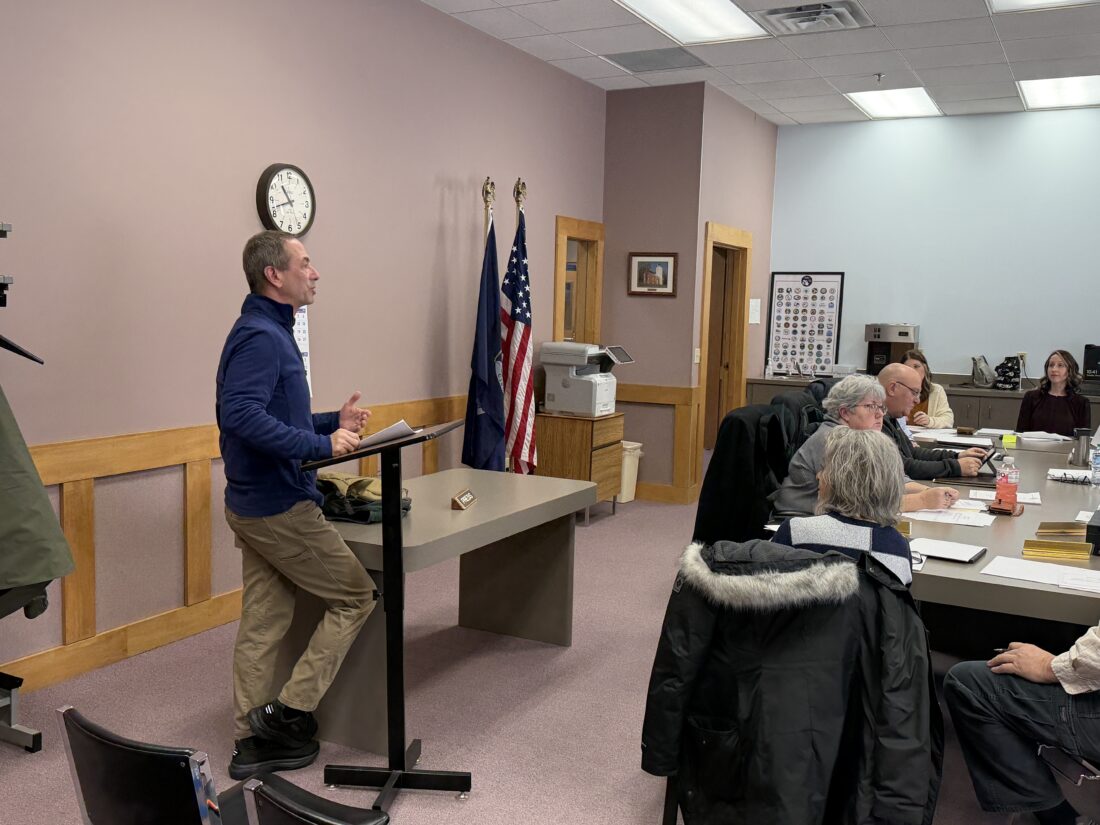
News photo by Kayla Wikaryasz On Tuesday, District Health Department No. 4 (DHD4) Medical Director Dr. Joshua Meyerson is seen giving a presentation about vaccine guidelines at the department’s monthly health board meeting.
ALPENA — District Health Department No. 4 (DHD4) Medical Director Dr. Joshua Meyerson reiterated the department’s intentions to comply with American Academy of Pediatrics (AAP) (67,000 members) and American Academy of Family Physicians (AAFP) recommendations for child vaccination schedules at Tuesday’s health board meeting.
Meyerson told health board members that the new U.S. Department of Health and Human Services (HHS) immunization guidelines, which were announced on Jan. 5, divert from prior recommendations from the Centers for Disease Control and Prevention (CDC). He said he is concerned that the HHS guidelines will create more confusion among parents.
“They’re very different from what the recommendations are coming from all of the major medical organizations and public health organizations,” Meyerson said. “My concern is it just leads to a lot more confusion.”
He explained that the differing guidelines create “more work for our providers” as they’re used to working off of a “harmonized immunization schedule.”
Meyerson said that in response to the new HHS guidelines, he is taking some vaccines and “switching them” to “shared clinical decision making” which places them in a category for certain groups of children. This is the case for immunizations such as the flu, rotavirus, respiratory syncytial virus (RSV), meningococcal, and hepatitis A and B vaccines.
“We no longer have that harmonized schedule … from our perspective, the health department, we will continue to follow the recommendations of the AAP and the AAFP,” Meyerson added.
He said that a positive of the HHS guidelines is that the Food and Drug Administration (FDA) and the CDC are allowing all routine “regular vaccines that children were getting” to still be available at no cost to those who are covered with Medicaid or are uninsured.
“So there’s not any change in the payment,” Meyerson said. “That was a big question. People wondered if their vaccines that they want would still be covered or they’d have to pay out of pocket. That’s not the case.”
Robert Brietzke, county commissioner and DHD4 health board member, asked Meyerson if he believes vaccines cause autism. Brietzke noted that his own grandson has autism.
“That is a really easy thing to tell you,” Meyerson said in response to Brietzke’s question. “Vaccines do not cause autism. I mean, it’s clear.”
Meyerson noted Andrew Jeremy Wakefield’s claims that the MMR immunization causes autism, which Meryerson said were proven untrue by “hundreds of studies that showed quite clearly MMR vaccine does not cause autism.”
“It was a reasonable question,” Meyerson said. “It’s been studied … in science, you can’t prove a negative. I can do thousands and thousands of studies that the sun is gonna rise in the east and set in the west. But I cannot tell you with 100% certainty that that’s gonna happen tomorrow. I just can’t.”
“If anything, the studies showed that vaccinated kids have a lower risk of autism,” he added.
Kayla Wikaryasz can be reached at 989-358-5688 or kwikaryasz@TheAlpenaNews.com.
Local News
Alpena Township Fire Department understaffed
Changes to Northeast Michigan Catholic churches
Thunder Bay National Marine Sanctuary hosts annual film festival
Prue promoted to equity partner at accounting firm
Culligan Plaza change in restroom hours
Due to recent vandalism, the Culligan Plaza public restrooms will have reduced hours of 9 a.m. to 8 p.m., effective ...