Alpena’s Matt Dunckel volunteers at Stifel Loppet World Cup

Courtesy Photo Matt Dunckel, Anne Gentry, and Don La Barre take a selfie at the Stifel Loppet World Cup in Minneapolis, Minnesota in February.
ALPENA — Matt Dunckel has been skiing since he was 8 years old, and this year he was able to volunteer at a premiere international cross-country skiing event.
The Alpena man traveled to Minneapolis, Minnesota to help at the Stifel Loppet World Cup, Feb. 16 and 17.
Friends and fellow Alpenans Don La Barre and Anne Gentry came out to watch the competition and support Dunckel in his volunteering role. All three are on the Thunder Bay Trails Association, which takes care of several local trails, including Norway Ridge Pathway, and encourages year-round outdoor recreation, including cross-country skiing.
Dunckel explained what the Stifel Loppet Cup is to the cross-country skiing community.
“In cross-country skiing, there are youth leagues, then there’s college, and then they go pro,” Dunckel said. “This is the series that the professional cross-country skiers perform at, the level that they perform at. And there are venues throughout Europe, mostly. So, what makes this so special … is 20 years in the making to get them here (to the U.S.).”

Courtesy Photo Crowds line the course at the Stifel Loppet World Cup in Minneapolis, Minnesota in February.
He said one of the main reasons it was able to be held in the U.S. this year is the women’s team.
“The U.S. women’s team has become very strong,” Dunckel said. “Jessie Diggins, Rosie Brennan. Now, there’s a group of young women coming in to fill the places — Jessie’s about to retire — Kikkan Randall was the first, and she was a sprinter, and so she won what’s called the Crystal Globe. They add up points, every time they do a weekend race, and that leads to the champion at the end.”
Randall, from Anchorage, Alaska, won the Crystal Globe three years, Dunckel said.
“It just blew everyone away that an American could be good at cross-country skiing,” he said.
The U.S. men are improving as well, Dunckel said.
“You get about 10 years in cross-country skiing,” he noted of the professional timeframe. “The last generation of men — Andy Newell, Simi Hamilton, they would, on a rare occasion, finish on the podium.”
He explained how cross-country skiing became popularized in the U.S.
“Back when Bill Koch, the original U.S. cross-country skier, he got a silver medal in the Olympics in ’76, and no one could believe it at that time because the Norwegians and the Italians and the Swedes dominated the sport. But Bill Koch, sort of, showed that it was possible.”
“That’s why everyone’s skis in Alpena are from the ’70s,” La Barre said. “Because everyone was like, ‘I want to do this.’ … He popularized it for Americans.”
Dunckel volunteered at the event for five or six days, he said.
“One of my tasks was to go to shepherd Will Koch, Bill Koch’s son,” Dunckel said. “He’s been having some success. He’s at Colorado University. He’s now on the World Cup because he did so well with college athletics. So, one of my jobs was to go pick up Will.”
He really enjoyed the entire experience volunteering.
“The whole weekend was cool, that way,” Dunckel said. “I never follow any other sport. I can’t even tell you a quarterback. But if I I was in football, it would be like me being able to sit down and have dinner with that quarterback.”
La Barre echoed that it was exciting and somewhat surreal just to be there in the same place as your heroes.
“It was bizarre,” La Barre said. “You just got to meet them. You’d be just sitting there, and be like, ‘Oh, look, that’s the number one athlete.'”
One person they saw up close was Federico Pelligrino, the top Italian cross-country skier in the world.
“It can be a somewhat accessible community,” La Barre said of the cross-country skiing world. “The reception of attendees at the World Cup was beyond wild.”
He said the athletes were talking about how great the U.S. crowds were as they cheered and supported them while they raced.
“The Europeans couldn’t believe how many people were there,” Dunckel said. “There were 15-20,000 people.”
“Each day,” La Barre added.
“They lined the entire course,” Dunckel said. “When Jessie went out, even to do a practice lap, you could tell where she was because of the roar of the crowd as she came around.”
“It was super cool,” La Barre said. “Because she’s from Minnesota. Currently, in the World Cup standings, she’s number one.”
Dunckel recalls the first time he tried skiing as an 8-year-old in a youth skiing program.
“My skis were way too long for me, and I didn’t know what I was doing,” he said. “But it was exhilarating to be sliding on snow, and it still is. I still have that feeling every time I put on my skis and I take off. And I can’t believe how easy it is.”
“And he dusts us,” La Barre said with a laugh.
“The more you do it, the better you get at it, and the more fun it is,” Dunckel said. “It’s a beautiful thing.”
-

- Courtesy Photo Matt Dunckel, Anne Gentry, and Don La Barre take a selfie at the Stifel Loppet World Cup in Minneapolis, Minnesota in February.
-
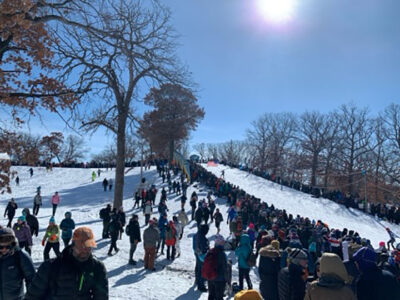
- Courtesy Photo Crowds line the course at the Stifel Loppet World Cup in Minneapolis, Minnesota in February.
Local News

Longing for summer

Alpena MSP post accepting donations for survivors of sexual assault

Harrisville library hosts Sole Survivor program

Gubernatorial candidate Mike Duggan visits Rogers City
Trail Roamers donate to Friends Together