
Ki Ki Cuyler, Northeast Michigan’s Most Accomplished Citizen
Up North Portraits
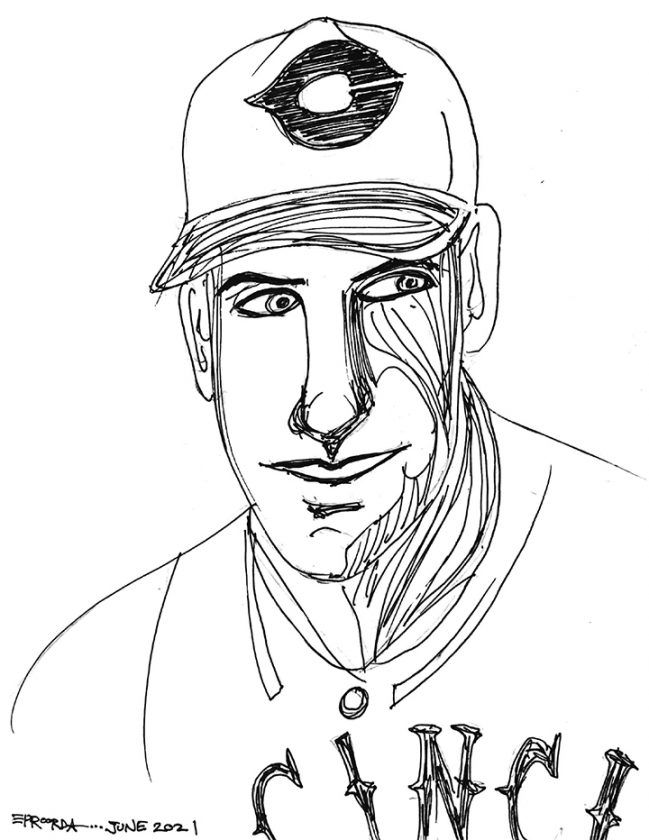
Ki Ki Cuyler
A handsome sign with a fieldstone foundation stands on the south edge of Harrisville, welcoming visitors to town. It’s well designed, with a lighthouse “I” and a wave motif. But it is not informative.
Back in the proverbial day, a different sign did the welcoming, located farther south than today’s, on the edge of St. Anne’s Cemetery. It was a small, hand-painted wooden billboard that announced, “Welcome to Harrisville, Home of Baseball Hall of Famer ‘Ki Ki’ Cuyler.”
Anyone then whose curiosity the sign may have aroused, could not pull out their “smartphones” to “Google it” on “the internet.” Those things came along about the time Ki Ki Cuyler’s billboard fell over.
But a few hundred yards farther along, newcomers then came across “Ki Cuyler’s Dugout Bar and Grill,” where they could stop, wet their whistles with a “shell” of Stroh’s, and hear all about Ki Ki Cuyler from his son Harold, or his granddaughter Candy, tending bar. There they could check out the glove he wore to roam right field; the bat he used to rack up a lifetime batting average of .320; and baseball cards that showed him in the World Series with the Pittsburgh Pirates and Chicago Cubs. Cuyler’s Bar burned down in 2018.
***
Hazen Shirley Cuyler’s father and mother came from Canada to Black River separately during the logging era, arriving in 1885 and 1889, respectively. George Cuyler, lumberman, and Anna Shirley, dressmaker, soon found each other in the frontier boomtown. Within a year of Anna’s arrival, the couple married. They moved into a nice house in the neighboring timber boomtown of Alcona.
The very next year, just as the trees were running out, George landed a great new job, becoming a member of the Sturgeon Point Lifesaving Station crew, one of seven “surfmen,” out of the 10 men stationed there. The main work of surfmen was to be prepared to row the lifeboat out to shipwrecks in all kinds of weather.
George and Anna moved into the little community clustered around Sturgeon Point Lighthouse in 1890. They brought their house with them from Alcona!
Hazen came into the world in that house on Aug. 30, 1898. After George sustained an injury that prevented him from performing the arduous task of rowing a lifeboat in raging waves, the Cuyler family moved to Harrisville. Again, they brought their house along, plunking it down on the road that became U.S.-23 years later.
George served as the Alcona County Register of Deeds and then as Probate Judge, becoming a community pillar. His son went to Harrisville High School, where he was the best athlete in the region and the smartest kid in his senior class of five students.
After graduating, Hazen Cuyler took a circuitous path to the Big Leagues. He married his girlfriend Bertha Kelly and went to Flint to work at Buick. When he wasn’t building cars, he was earning extra money playing semi-professional baseball for the Bay City Club of the Michigan-Ontario League. That’s where a sharp-eyed scout for the Pittsburgh Pirates spotted him, and signed him to a Minor League contract.
Cuyler streaked through the Minors in four years. In his last year, he was MVP of the Southern League, a prize that came with a giant 1923 sedan. After the season, he drove it home with Bertha, where it must have caused quite the sensation! (Bertha was Hazen’s companion throughout his career, making a home for him to be at home, whenever he wasn’t on a road trip.)
As a rookie the following season, Cuyler scorched the National League with one of the best debuts in history, hitting .354. In his second year, he led the Bucks to a World Series title. If there had been an MVP Award for the Fall Classic then, he would have won. He doubled in the decisive run in the eighth inning of Game Seven.
By then, his high school nickname “Cuy” had morphed into “Ki Ki,” due to radio announcers’ confusion about the echoed shouts of “Cuy” they heard from Hazen’s teammates and fans.
Traded to the Chicago Cubs, “Ki Ki” continued his great play, taking his team to win the pennant. During those years, he often led the league in stolen bases; was among the best hitters; and guarded right field in a way few players could, then or now.
Also during those years, Cuyler’s meteoric rise in the Bigs was a happy distraction for the people of Harrisville, who endured twin fires in 1926 that wiped out nearly every structure on Main Street.
Playing for the Cincinnati Reds, Hazen hurt his knee and had to stop playing. But he started managing, and kept winning, leading the Chattanooga Lookouts and the Atlanta Crackers to championships. The Boston Red Sox hired him as a coach, a position he was scheduled to fill for the 1950 season.
But Hazen suffered a heart attack while ice-fishing that February, and after a struggle with pneumonia in a hospital in Ann Arbor, he had a second cardiac arrest, which killed him. He was only 51 years old. Bertha outlived him for more than four decades. (My mother often played bridge with her.)
***
Had Cuyler lived, he might have become a legendary manager. He might have been inducted into the Hall of Fame not only as a player, which he was in 1968, but also for his coaching. He would have been 70 in 1968. Would he still have been managing then, the way Tony LaRussa, the 76-year-old manager of the White Sox, does today? He was off to a great start…
Ki Ki and Bertha Cuyler always came home during the off season, where they were familiar and well-loved figures. He sang in the choir at St. Anne’s Church, belonged to umpteen organizations, and was among the founders of the Harrisville Lions Club, which is still going strong.
Today, you have to look very closely to find a sign–the sign–of Ki Ki Cuyler. There’s a little green one that designates a stretch of M-72 as “Ki Ki Cuyler Memorial Highway.” That is very nice.
But a State of Michigan historical marker would be better. It could stand on the Alcona County Courthouse Green, near where Ki Ki attended the old Harrisville High School, close to the highway, not far from his moveable birthplace, so that baseball buffs can learn about Northeast Michigan’s most accomplished citizen.
Eric Paul Roorda, Ph.D., is an author, artist, and college professor. More importantly, he is a cartoonist and occasional columnist for The Alpena News. His political cartoons appear on Mondays, and “The Whitetail Family,” a coloring book in serial form, appears on Saturdays on the “Outdoors” page. Order the coloring book for $15 at eproorda@gmail.com.
Lifestyles

Lots happening in for Presque Isle District Library
Alpena DDA seeking donations for downtown flower fund
Pizzapalooza event for Relay for Life
ALPENA — On April 16 from 6 p.m. until 8 p.m. take a night off from cooking to Support the Relay for Life of ...
Rogers City Growing Green Luncheon
ROGERS CITY — Welcome Spring with the Presque Isle Co. Garden Club. The 14th Annual Growing Green Luncheon is ...

Teams, sponsors sought for Habitat Bowl to Build April 17
April is Child Abuse Prevention Month
ALPENA — April is Child Abuse Prevention Month and the Alpena and Presque Isle Child Abuse and Neglect (CA/N) ...