
Posen farm works the fall harvest

News Photo by Julie Riddle Styma Potato Farms co-owner Randy Styma keeps an eye on a digital screen while navigating rows of harvest-ready potatoes near Posen.

News Photo by Julie Riddle Reflected in the green-tinted window of a harvester, a truck driver carefully steers alongside, catching potatoes freshly pulled from the ground.

News Photo by Julie Riddle A worker at Styma Potato Farms in Posen strides across rows of potato plants to fix a stalled machine.

News Photo by Julie Riddle A rock, sucked from among harvested potatoes by a giant vacuum, rides on the rotating belt of a harvester at Styma Potato Farms.

News Photo by Julie Riddle Farmers need to know how to fix everything. Workers at Styma Potato Farms in Posen lie beneath stopped farm equipment to make a fix at the beginning of the fall harvest.
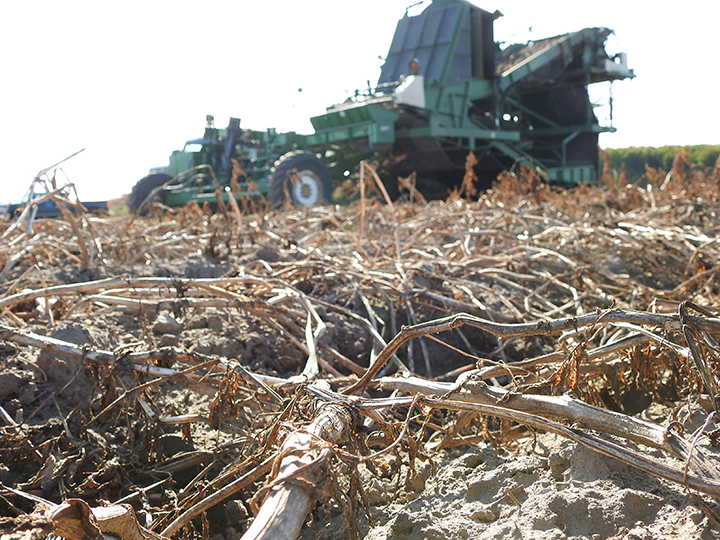
News Photo by Julie Riddle A harvester looms above potato plants ready for harvest.

News Photo by Julie Riddle Potatoes patiently wait in line to be scooped up by a harvester at Styma Potato Farms in Posen.

News Photo by Julie Riddle Seagulls circle as a winrower upturns the soil in search of potatoes.

News Photo by Julie Riddle A steady stream of taters rolls off of a harvester into a truck.

News Photo by Julie Riddle Losing only one or two of its passengers along the way, a loaded potato truck heads to a storage facility.

News Photo by Julie Riddle Freshly dug potatoes are dumped onto a conveyor belt as a truck unloads at Styma Potato Farms. If all goes well, a full truck can be unloaded in only about five minutes.

News Photo by Julie Riddle Potatoes travel in style down a conveyor belt, headed to a storage facility where they may spend up to a year in cool darkness.

News Photo by Julie Riddle Workers scan for unwanted rocks or plant parts as potatoes are transported into a storage facility.

News Photo by Julie Riddle A mountain of potatoes rests under the arched roof of a storage facility. The blue tubes allow for temperature regulation both above and below the potatoes.

News Photo by Julie Riddle In the shipping center of Styma Potato Farms, workers prepare boxes to be loaded and sent to the southeastern U.S.

News Photo by Julie Riddle As farm owner Edwin Styma walks by, bags wait to be loaded with potatoes that will someday be somebody’s dinner.

News Photo by Julie Riddle Edwin Styma watches as potatoes leave the giant, spinning tube in which they’ve just gotten a wash and ride an escalator to a drying rack.

News Photo by Julie Riddle Potatoes tumble dry on soft foam rollers under the supervision of owner Edwin Styma at Styma Potato Farms in Posen.
News Photo by Julie Riddle Styma Potato Farms co-owner Randy Styma keeps an eye on a digital screen while navigating rows of harvest-ready potatoes near Posen.
News Photo by Julie Riddle Reflected in the green-tinted window of a harvester, a truck driver carefully steers alongside, catching potatoes freshly pulled from the ground.
News Photo by Julie Riddle A worker at Styma Potato Farms in Posen strides across rows of potato plants to fix a stalled machine.
News Photo by Julie Riddle A rock, sucked from among harvested potatoes by a giant vacuum, rides on the rotating belt of a harvester at Styma Potato Farms.
News Photo by Julie Riddle Farmers need to know how to fix everything. Workers at Styma Potato Farms in Posen lie beneath stopped farm equipment to make a fix at the beginning of the fall harvest.
News Photo by Julie Riddle A harvester looms above potato plants ready for harvest.
News Photo by Julie Riddle Potatoes patiently wait in line to be scooped up by a harvester at Styma Potato Farms in Posen.
News Photo by Julie Riddle Seagulls circle as a winrower upturns the soil in search of potatoes.
News Photo by Julie Riddle A steady stream of taters rolls off of a harvester into a truck.
News Photo by Julie Riddle Losing only one or two of its passengers along the way, a loaded potato truck heads to a storage facility.
News Photo by Julie Riddle Freshly dug potatoes are dumped onto a conveyor belt as a truck unloads at Styma Potato Farms. If all goes well, a full truck can be unloaded in only about five minutes.
News Photo by Julie Riddle Potatoes travel in style down a conveyor belt, headed to a storage facility where they may spend up to a year in cool darkness.
News Photo by Julie Riddle Workers scan for unwanted rocks or plant parts as potatoes are transported into a storage facility.
News Photo by Julie Riddle A mountain of potatoes rests under the arched roof of a storage facility. The blue tubes allow for temperature regulation both above and below the potatoes.
News Photo by Julie Riddle In the shipping center of Styma Potato Farms, workers prepare boxes to be loaded and sent to the southeastern U.S.
News Photo by Julie Riddle As farm owner Edwin Styma walks by, bags wait to be loaded with potatoes that will someday be somebody’s dinner.
News Photo by Julie Riddle Edwin Styma watches as potatoes leave the giant, spinning tube in which they’ve just gotten a wash and ride an escalator to a drying rack.
News Photo by Julie Riddle Potatoes tumble dry on soft foam rollers under the supervision of owner Edwin Styma at Styma Potato Farms in Posen.
Trending
POSEN -- Tradition mingles with dazzling technology to produce tons of taters each year in the fertile fields surrounding the quiet town of Posen.
The humble potato, the cherished vegetable of the Posen area -- rooted in the Polish culture of the region and sprouting an annual festival all its own -- takes center stage for farmers who invest time, money, and heart into coaxing spuds out of the soil and onto plates across the nation.
At Styma Potato Farms, the potato cycle begins in spring, with chunks of seed potato planted in neat, mounded rows.
The microclimate of the Posen area -- with high humidity and abundant water -- blends with the knowledge of the Old Country to make an ideal potato-producing environment, said Erwin Styma, co-owner of the farm with his brother, Randy.
Fourth-generation potato farmers, the brothers work the land first loved by their great-grandfather, who started a little-bit-of-everything farm after relocating from Poland.
At harvest time -- usually the middle of September through Oct. 25, in a good year -- sturdy machines trundle through the fields, scooping potatoes from their underground beds.
As seagulls flurry overhead in hopes of snagging upturned worms, two large winrowers ferry potatoes into neat rows, in turn to be peeled from the field by an even larger harvester. As they're pulled onto the machine, an enthusiastic, super-sized vacuum sucks the first layer of dirt from the tubers and separates out rocks to be dumped unceremoniously back onto the field.
Check out a video of the fall harvest at Styma Potato Farms. Viewing on mobile? Turn your device horizontally for the best viewing experience. Story continues below video.
Some fancy driving is needed as a carrier truck drives alongside the harvester to catch a cascade of potatoes -- especially when the driver of a new truck has 30 seconds to navigate into place when the first truck is filled to the brim.
From the field, potatoes are trucked to one of eight controlled-climate storage facilities -- curved-roof huts where 3.2 million pounds of spuds loom several stories high in the dim, cool light.
A high-tech computer system regulates the temperature of the oversized potato bin, raising and lowering the giant doors of the facility as it tracks outdoor temperatures and blowing air through a room-high humidifier vent.
Keeping air flowing and the humidity high means the potatoes can sit for up to a year, waiting to be packed and shipped, Edwin Styma said.
At the farm's packing facility, potatoes tumble through two washing cycles, ridged conveyor belts and a slowly rotating tube giving them a thorough -- but hands-free -- cleaning before sliding them onto a moving drying rack and under heat lamps to finish their pre-packing spa treatment.
The whole, rowdy bunch is conveyered to a newfangled sorting machine that seems too spud-smart to be true.
With potatoes lined up single-file and whizzing past at top speed on rails, eight cameras inspect the vegetables on the fly, using mirrors and angles to determine in an instant where each ought to be sent, based on its size.
The cameras trigger small levers farther down the line that snap on cue like pinball flippers, sending potatoes flying into the appropriate giant holding bin.
The last stop for each potato is the packing station, where they are loaded into bags, from five-pound totes to 2,000-pound super-sacks, ready to be shipped wherever someone wants to put a tater on their table.
A small but smart machine uses its electronic brain to weigh each potato as it passes, sorting and selecting to fill each five-pound sack with exactly five pounds of potatoes.
Most of Styma's potatoes go to the southeastern U.S., although some end up in Michigan.
Farming isn't an easy business, and the potato trade is dirty, physically tiring work that waits upon the whims of Mother Nature for prosperity.
"We've had some adversity and hardships along the way," Styma said with the understated nonchalance of a farmer. "But, who hasn't?"
This summer, while the food service portion of their business has taken a hit, sales to grocery stores have done well, Styma said.
The coronavirus pandemic, while making some parts of life challenging, has also had the side effect of teaching people to cook, some for the first time, Styma said.
For himself, he's happy to have a forkful of potato -- "Hash browns, mashed, you name it," he said -- as the annual potato harvest got underway.
Julie Riddle can be reached at 989-358-5693, jriddle@thealpenanews.com or on Twitter @jriddleX.