ACC’s Kuehnlein to address ALL about Europe trip, Brexit
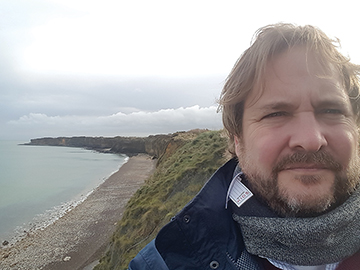
Courtesy Photo Tim Kuehnlein at Omaha Beach, Normandy, France, site of D-Day operations.
The public is welcome to join the Association of Lifelong Learners to hear from Tim Kuehnlein, instructor of political science and history at Alpena Community College, about his recent trip to Paris, France, Brussels, Belgium, and the surrounding areas. He will share his experiences and insights about the current state of affairs in Europe, and Brexit, from 7 to 8:30 p.m. Thursday at ACC, CTR 116.
Brexit is a term that combines the words “British” and “Exit,” referring to the United Kingdom, also known as Britain, and its decision to separate from the European Union.
“It’s just a term that was coined as this whole controversy was developing in 2016, which is when the British actually voted in a referendum, to separate, by a slim margin, to separate from the European Union,” Kuehnlein explained. “Their history’s always been really tenuous with the European Union; They’re not part of the mainland continent, so they’ve always been kind of on the periphery, and then with the history of the French and the Germans, they’ve always kind of stood by the side and cautiously observed what’s going on.”
In addition to educating folks about Brexit, Kuehnlein will touch on some of the other sites he visited and sights he saw on his trip. He spent a little more than two weeks in Europe, from Dec. 15 to 31.
“It’s the 100th anniversary of the end of World War I, so it was an opportunity to visit Flanders Fields, which was really moving,” he noted. “Even though it really wasn’t our war and we didn’t come into it until the end, we helped solve that crisis. And some of the last battles of that war were fought in that area of Belgium. … I also had a chance to go to Normandy and see the D-Day invasion beaches.”
“I made a point of maximizing my time there,” Kuehnlein said of his trip to Europe. He traveled with a friend on his own time.
He said the situation in Europe heightened this past November, so he was somewhat anxious about the trip.
“Not only do you have the Brexit controversy, but the location where I was going initially, Paris, we saw demonstrations emerge in November, and they got increasingly more significant into December, then became violent,” he said. “And it was kind of nerve-wracking going into that, not knowing exactly what was going to happen.”
Ultimately, that didn’t stop him from this experience of a lifetime.
“But you can’t act out of fear. You’ve just got to be careful, smart, observant and just avoid things that look troubling,” he noted. “Even though there was a little bit of anxiety there, going into it, there’s an excitement as well because you’re kind of witnessing history in the making.”
He explained that yellow vest protests have been taking place in Paris and all throughout France.
“While we were there, the protests were spreading into Belgium, and Hungary. It’s just a very volatile time right now.”
He said while all this is happening overseas, there is a connection to us in the U.S., and we should be paying attention.
“It’s so far removed from us, but there are experiences that are happening elsewhere in the world that are similar to what we’re struggling with here,” he said. “What you see is these are global phenomenon that, if you can step back and just see the connections here, it really makes you stop and think, ‘Ok, what’s actually happening?’ because we’re all kind of being impacted by these forces.”
“The yellow vest protests are basically lower-middle-class French people who are being increasingly put in a situation where they just can’t afford to survive,” Kuehnlein explained. “Their wages are so low, but they can’t afford to live in the city center. They’re being forced to move farther and farther out of the city center to the sub-suburbs. But they can’t afford cars. They can’t afford housing in the center. But they’re so far out that a lot of the public transportation doesn’t go that far out yet. So they have to have cars in order to get in, and maintain their jobs.
“Well, gas in Europe is about $8 a gallon, and granted, they don’t have to drive as far, but part of the problem is, there are so many people driving that these European cities are just so congested with traffic,” he continued. “People sit for hours in traffic jams. Gas is so expensive, these people can hardly afford cars, let alone the gas. And the government just imposed serious taxes on gasoline. Which, of course, threw a lot of people through the roof.
“And they’re coming out in protest and trying to get government to respond to them,” he said. “And the president of France right now is being perceived as aloof, like he’s not really connecting with average people. But France is also facing major challenges, budgetary-wise. They have a huge social network that is costly and it begs the question ‘Who’s paying for it?’ and can they afford it. But they’re also dealing with environmental issues and pollution, especially in these cities, because the cars are sitting there idling, it’s wasting this expensive gas, it’s creating a pollution that’s affecting the environment of the people in these cities. So it’s just a really nasty bottleneck of issues, and it’s blowing up, in terms of population reacting. And then, it’s gotten violent. As with anything like this, it was peaceful initially, then fringe groups latch on and it just spirals into a mess.”
He said the protests have migrated further into the surrounding countries.
“And then while we were there, they were starting to demonstrate in Brussels as well, because of immigration policy being passed by the European Parliament,” Kuehnlein said. “Europe is dealing with some of the same kinds of things we’re struggling with, in terms of mass immigration. And which level of government is shaping policy, and how that impacts population counts, and subsequently, job opportunities, and social services, and costs. So, there’s some really interesting comparative perspective there.”
“I went into this knowing that I would have an opportunity to visit the European Parliament, because one of the three sites is in Brussels,” he explained. “Brussels is considered the capitol of the European Union.”
Kuehnlein is looking forward to sharing his perspectives and experiences with ALL attendees on Thursday.
“The beauty of travel is that you can bring those experiences back and share,” he said. “It’s a unique opportunity,” he said of the ALL presentation. “It’s fresh. It’s happening before our eyes,” he added, referring to Brexit.
His intent is to help others understand the situation more clearly so they can see how it applies to their own lives.
“I think a lot of people are either not even aware of it, or they’re hearing it, but it’s so complex, that it’s hard to connect the dots,” Kuehnlein said of Brexit. “That’s ultimately what I’d like to do for those people who are interested.”
“It does have relevance to us,” he noted. “These are our partners, our trading partners, and our mutual defense partners. It they’re fighting among themselves, and their coherancy is not sustained, we all know the history of Europe, and it’s not pretty. But there’s a magnificent success story here of peace, that’s almost unprecedented.”
He likened the situation to that of a state leaving the U.S.
“What would truly happen if Texas decided to leave the United States? How would that be handled? … Well, this is what’s happening in Europe, and the question is, can they do it without the relationship deteriorating … you can imagine, over time, if they can’t figure out how to amicably divorce, that tension only undercuts the potential for trade, prosperity.”
“And we know, just with the dynamics of the trade wars going on right now, it can really bog down the sense of security and safety and peace,” Kuehnlein added. “Again, these are our partners. These are our allies. So, it does have repercussions for us. It’s not that far-removed.”
He explained that immediate effects would include transitioning into trade with two separate entities, the U.K. and the E.U.
“Imagine if we had to deal with every one of the 27 other members of the E.U. separately,” he said.
“You’ve got every industry, every trading relationship, that’s going to have to look at these dynamics,” he noted. “… So it gets really messy, and it will get messy very quickly, within two years.”
The Brexit departure deadline is March 29.
“Borders are going to go up between Britain and the European Union as of the end of March, unless they find another negotiated agreement,” Kuehnlein said. “This is so significant long-term, we may not even fathom it right now.”
For more information on Brexit, see the article “What Is Brexit? A Guide to Why It Matters and What Happens Next” at
https://www.nytimes.com/interactive/2019/world/europe/what-is-brexit.html.
For more information about Thursday’s presentation, or about ALL programs, call 989-358-7207 or visit www.associationoflifelonglearners.org.
Lifestyles
Longing for summer

Harrisville library hosts Sole Survivor program
Trail Roamers donate to Friends Together
Community Foundation announces new officers

Lots happening in for Presque Isle District Library