30K pizzas to go … into a landfill
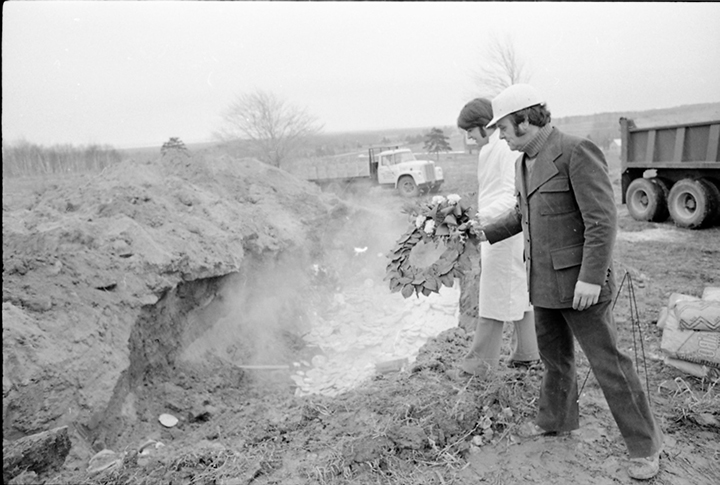
Courtesy Photo Papa Fabbrini pizzas are dumped into an 18-foot hole in an Ossineke field in 1973 in this photo provided by the Alpena County Library’s Special Collections Department. As part of a bid to reclaim public trust after a contamination scare, the Ossineke-based pizza company dumped 30,000 pizzas into the big hole, at a cost equivalent to $200,000 in 2022 dollars.
OSSINEKE — Tainted food incidents offer an interesting and tragic history.
Fortunately, in many instances, the U.S. Food and Drug Administration and U.S. Department of Agriculture were able to identify the contaminated foods.
For instance, in 1959, America faced a Thanksgiving holiday of recalled cranberries that were sprayed with a deadly herbicide. That year, the White House and American households served applesauce with the turkey holiday dinner.
In recent years, Capri Sun beverage pouches contained cleaning fluid, Purdue chicken possessed blue dye and plastic particles, Wendy’s hamburger lettuce and Dole bagged salad offered listeria, and Jif and Peter Pan peanut butter were tainted with salmonella.
Nearly 50 years ago, in 1973, Northeast Michigan became involved with a major food recall with tainted Papa Fabbrini’s frozen pizza.
The history goes back to when Italian natives Ilario (Mario) Fabbrini and his wife, Ogla, immigrated to the U.S. just after World War II. Subsequently, he served in the U.S. Army during the Korean war.
Eventually the Fabbrini couple moved to Detroit, where they used their creative culinary talents and a family recipe to sell and deliver frozen pizzas to the public, area restaurants, and taverns.
In the late 1960s, Fabbrini was approached by the H.J. Heinz Co. to manufacture frozen pizzas for Michigan and Ohio distribution. His pizza production empire moved to Ossineke. In an assembly-line approach, the plant could weekly produce 45,000 family-size frozen pizzas.
Papa Fabbrini’s production was a unique early-on approach to America’s frozen pizza market.
In an Alpena News interview, Fabbrini stated: “In those days, you have to understand, the space in the grocery store was not more than five or six feet for frozen pizza. Today, you have hundreds of miles of pizza in the grocery store. In the old days, to get space, you had to fight for it.”
In January 1973, employees at Ohio-based United Canning, which supplied Papas with mushrooms, were checking their canned inventory. They noted that the tins had swelled up. That appeared to have occurred when the company switched from a manual can-filling process to an automated process.
Suspecting food contamination, the FDA began a massive recall and testing process. Samples of the mushroom-ladened pizza were given by FDA officials to mice. The rodents died.
Media accounts stated at least 17 individuals made food poisoning claims against Papa Fabbrini.
By February 1973, Fabbrini underwent an FDA recall of his pizza. He brought down the facility’s employee count for production and distribution people.
To maintain some level of production, he brought on family members.
Other frozen pizza competition moved in to fill the vacant Papa Fabbrini’s grocery frozen food shelves, as well as with restaurant distribution.
In a quest to regain public trust, Fabbrini opted on March 5, 1973, to load four dump trucks with nearly 30,000 frozen pizzas and bury the cellophane-covered pizzas into an 18-foot-deep Ossineke field hole.
With then-Gov. William Milliken, local dignitaries, the media, and the general public present, the “great pizza funeral” occurred. The event received international media coverage.
The cost to dispose of the pizzas in 1973 dollars was at least $30,000. In 2022 dollars, that converts to more than $200,000. The disposal was also designed to regain consumer trust.
Papa Fabbrini’s pizza production fate did not end that March.
Fabbrini later learned the FDA retracted their claim that mushroom botulism contaminated the pizzas. The FDA determined the mice succumbed to an unrelated food contamination.
Rumors abounded that Fabbrini received a million-dollar lawsuit settlement against the canning company. He later revealed that was not true. Rather, after legal fees, he received $211,000.
Those funds were used to underwrite operating costs, keeping the company in a limited production mode.
After struggling for years, in the early 1980s, Fabbrini sold his company, assets, and recipe for $5,000. Soon thereafter, the company failed and closed its doors.
Indeed, a true Northeast Michigan “one of a kind” story, which went from the freezer not into the oven but into an 18-foot farm field grave.
Jeffrey Brasie is a retired health care CEO. He served in the U.S. Navy and U.S. Naval Reserves and was on the public affairs staff of the secretary of the Navy. He is a former Alpena resident now residing in suburban Detroit.
Local News

Protect the places you love during PlayCleanGo Awareness Week, June 6-13
Charity at work for children

Alpena City band begins season Thursday

Special education data shows improvement in graduation rate and fourth grade literacy

‘Ol Glory says goodnight